



Sustainability Urban Planning Framework
Sustainable Urban Planning Framework


Written By:
Pedro Nascimento, Sustainability Consultant
1. Introduction
Over the course of the past two decades, sustainability has moved from a niche concern to a defining criterion of professional practice in Urban Planning.
What began largely as a response to energy crises and isolated environmental advocacy has evolved into a generalized design imperative (serving Terra Nexus’ own objective of Building with Nature as a clear example). Driven by mounting evidence of climate change, resource scarcity, and the built environment’s outsized responsibility on global energy consumption and carbon emissions, the construction sector accounts for roughly a third of worldwide energy use.
This shift has been reinforced by tightening regulation in leading markets, investor and insurer pressure for climate risk disclosure, along with an ever-growing list of clients who increasingly treat sustainability commitment and certifications like LEED, WELL, or Estidama’s PEARL system as baseline expectations.
As the discipline matures, sustainability shifts from an add-on layer applied late in design, to an integrative process shaping site selection, material sourcing, energy and water strategies, occupant health, climate adaptation and resilience planning from the earliest stages of project visioning and pre-concept planning.
Naturally, the project lead is expected to entail a team comprising specialists from different disciplines, ranging from planners and engineers to other professionals that may vary with each project’s context, in areas such as environment, sustainability, acoustics, fire life safety, coastal engineering, landscaping, mobility, among others. This guarantees that all a specific project’s required values are properly met throughout the design’s different stages.
The integration of a sustainability consultant at early stages of project design/ideation allows for higher levels of the client’s initial vision and urban arrangement optimization, already guaranteeing the integration of critical yet extremely beneficial measures related to matters such as building shape, orientation and landscaping options.
This way, once infrastructure and related services are integrated into a project’s design, otherwise difficult to implement solutions have already been considered, and benefits can be guaranteed for the operational stage of the project’s lifecycle.
Differently from what is verified for Environment, Sustainability is not a mandatory discipline per se – however – countries around the globe have already begun to implement specific regulations to establish a baseline for future project developments.
Market forces, however, mostly originating from clients, authorities, competitors and investors, are what currently set the bar for new projects’ sustainability targets, as companies within regions such as the Middle East, Europe and the United States seek to outperform each other with every project put through.
The resulting subjectiveness in the way Sustainability is approached allows for different application methodologies and understandings of its true purpose, being all commonly unified by compliance to different green certification systems such as LEED, BREEAM, MOSTADAM, PEARL, ENVISION or WELL, which provide a general structure where one does not usually exist.
As a result, and as part of its goal of Building with Nature, Terra Nexus has been assessing the key opportunities and challenges associated with effective implementation of Sustainability and Environmental objectives in an urban planning project’s lifecycle.
Together with vast experience and expertise in environmental compliance, GIS, urban planning, waste management and ecology, Terra Nexus has now developed a “Sustainability Urban Planning Framework” that puts project proponents and stakeholders’ sustainability goals and objectives at its core, while facilitating the implementation of impactful measures when and where they matter the most, as to attain project and operational optimization.
The following article illustrates Terra Nexus’ methodology and implementation of this Framework, in line with the urban planning process and outlining why, where, how and when specific measures should be applied.
2. Typical Urban Planning Workplan
Master Planning projects are typically led by an appointed planning firm, which then structures a project’s workplan in accordance with current market’s predetermined five development stages*, being:
Stage 0: Business Plan and Vision (also known as Ideation Stage)
Stage 1: Data Collection & Analysis
Stage 2: Pre-Concept Masterplan
Stage 3: Concept Masterplan
Stage 4: Detailed Masterplan
*specific stage components may remain outside the client’s responsibility throughout each/different project development phase.
Similarly to what happens for Environment, Sustainability tasks span across different project stages, being the outcome of the sustainability specialist’s work a reflection of all of the coordination held at different stages of design.
Induction at earlier stages (such as Stage 0) are prone to generate higher effective gains when compared to others, as principles such as building massing, energy, water and material demand reduction and resident wellbeing can be reinforced prior to any preliminary development of the design.
3. What is Sustainability’s role in Urban Planning?
Applicable at both asset and urban planning scale, sustainability ranges from a building-level concern to a systemic one, providing greater focus on how cities grow, move, and consume resources over time.
Urban planners are increasingly treating land use, density, and connectivity as sustainability tools. Compact and mixed-use developments reduce vehicle dependency and infrastructure sprawl. Integrated transit networks, supporting walkability, and green and blue infrastructure (parks, urban forests, permeable surfaces, natural drainage) help cities manage climatic challenges (such as stormwater, urban heat island effect) while preserving ecological function even as populations grow.
Climate volatility is considered a fundamental part of the sustainability consultant’s role such as accounting for risk of flooding, extreme heat events, and resource stress. These risks require consideration in zoning, infrastructure sizing, and public space design, rather than addressing them in the aftermath of such events.
Social dimensions matter just as much as environmental ones, as equitable access to housing, transit, amenities, and the preservation of local character and community identity are considered core to what makes a plan effectively “sustainable” and well-integrated.
In summary, Sustainability can be defined as the specialty that targets not only a project’s optimization from a resource and demand perspective but also pays particular focus to the proper integration of a specific project to its natural environment, culture and surroundings.
4. What are Sustainability Aspects?
Each project poses an opportunity for the development and integration of novel sustainability measures, considering the unique nature of every planning exercise.
Upon a project’s induction, the initial evaluation of its conditions, challenges and main objectives are to ultimately be translated onto a setlist of “Sustainability Aspects”. Those are the matters that must be prioritized as to attain the project’s defined sustainability strategy. This helps categorize key elements that shall be examined across relevant disciplines to identify, benchmark and develop measures that address the sustainability aspirations for the project.
Sustainability aspects incorporate matters intrinsic to Sustainability, such as “energy” and “water efficiency”, in addition to less common aspects such as “urban food production” or “flood risk management”, that may be imperative to a project because of its context or project proponent’s requirements.
Upon its identification, a Sustainability Aspect is characterized in close collaboration with the relevant disciplines to support developing appropriate and novel solutions that support the alignment of both design and sustainability intents of the project.
Based on our experience, we have identified 8 typical Sustainability Aspects described below. This is not an exhaustive list but provides a foundational scope for assessing the sustainability challenges and opportunities for every project.
- Building Design and Urban Arrangement: Targets the optimization of proposed building form and orientation (ranging from iconic to commercial, service and residential buildings) towards lower operational impacts, and street arrangement (location of buildings, street orientation, trees and other public features placement, etc) based on model analysis, literature and benchmark studies.
- Public Spaces and Places of Respite: Targets the creation of resource efficient public spaces, containing both places of respite and interest to the community, while providing means of navigation through appropriate landscape planning.
- Location and Means of Transportation: Targets the analysis (based on the mobility consultant team’s inputs) of expected and potential means of transportation within the project area, while assuring the feasibility and practicality of integrating specific transportation models.
- Biodiversity and Natural Resources: Aims for proper integration of environmental values and opportunity potentiation within the design, facilitated by efficiencies with Terra Nexus’ Environmental Urban Planning Framework and design support services.
- Energy Sources and Demand Reduction: Provision of initial assessments on renewable (alternate) energy production potential and novel technologies for implementation, as well as optimization measures for buildings and public areas.
- Water Management and Resource Usage: Provision of assessments on water sourcing and recovery opportunities, as well as optimization measures for buildings and landscaping.
- Waste Management and Reduction: Reliance on Terra Nexus’ in-house knowledge on waste management to propose novel and benchmarked waste management processes targeting the 7R principle of impact reduction, lowering the development’s burden on existing and projected waste management facilities.
- Carbon Footprint: Provide a consolidated overview of the project’s carbon balance, considering baseline conditions and optimized iterations of the masterplanning exercise, entailing a high-level assessment of expected carbon-specific and other aspects’ demand reduction measures impact on overall carbon emission reduction.
Measures and Key Performance Indicators (KPIs) are developed for each of the aforementioned aspects, with additional aspects added as applicable. KPIs will vary from project to project, considering climatic context, regional policies and priorities, and project vision.
Assessment of established KPIs and compliance review of the identified measures goes hand in hand with the integrated design process. Throughout the different design stages of the planning process, individual aspects are periodically examined and developed alongside the specialist disciplines. This will culminate into a comprehensive report of how and where the project’s main challenges have been identified and addressed, from project ideation to detailed masterplan.
Table 4‑1: Sustainability Aspect Assessment Process (per stage)
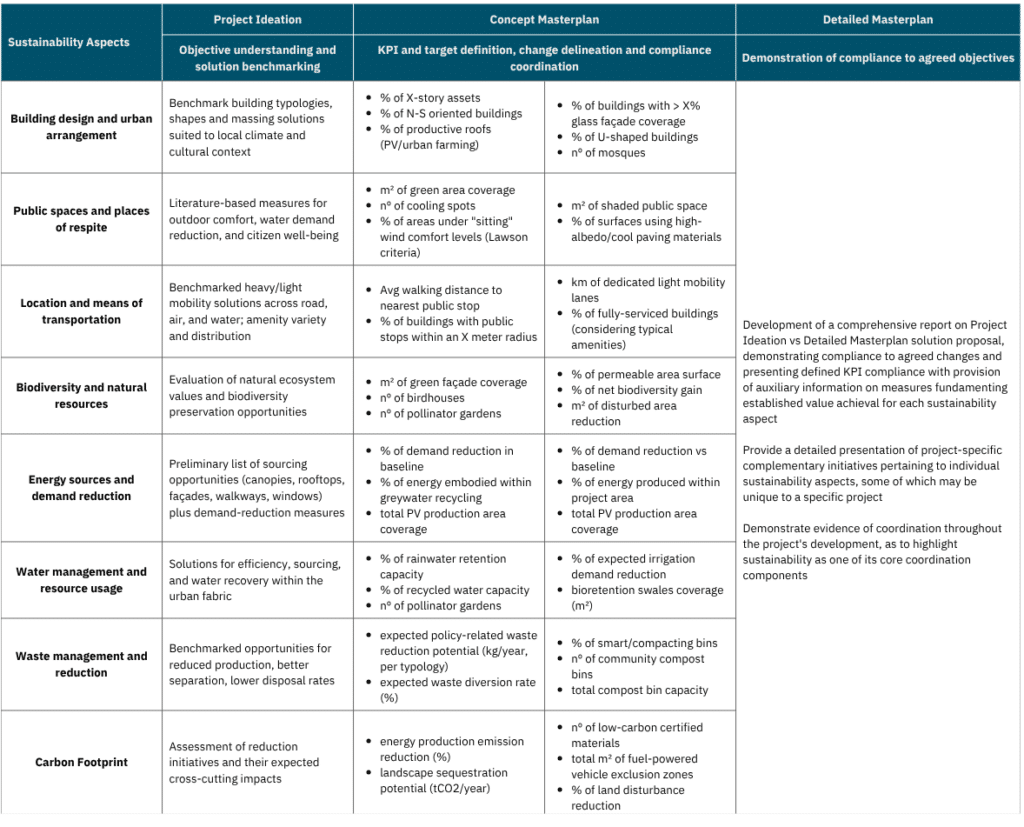
Project stages and timelines vary significantly, raising the question of how we plan for an agile and integrated methodology while still ensuring timely consideration of all identified aspects at the start of a project, a matter we thoroughly assess below.
5. Integration Methodology
As previously mentioned, the benefits of integrating sustainability at early stages of design are tremendous, and associated opportunities are mostly circumscribed to these specific periods of development.
With this, Terra Nexus’ developed Sustainability Framework sets to define critical coordination and development steps for each stage of a standard planning process, as to properly understand and optimize a project design in accordance with its identified sustainability aspects of relevance.
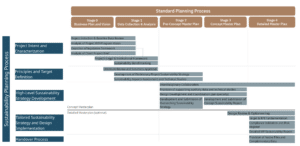
Figure 5.1: Terra Nexus’ Sustainability Planning Process
As seen from the figure above, five different sustainability planning process phases have been identified and spanned throughout the standard urban planning process, each entailing specific steps that are to be catered and adjusted in accordance to the client’s planning structure and development timeframes as per the narrative below.
5.1 Phase I – Project Intent and Characterization
The initial step of the process delves into understanding the project’s overarching context in relation to regulatory requirements, RFP objectives and clients’ expectations, as to guarantee a proper delineation of the project-specific Sustainability Strategy to be implemented afterwards, relating to what is usually defined as Stage 0 of a typical urban planning process (Business Plan & Vision).
Properly understanding the overarching project context is fundamental not only to guarantee project compliance, but also to ensure proposed measures are well aligned with what has been initially defined as the project intent and properly supported by overarching regulatory framework/regional focus.
The steps within this initial phase are to ultimately result in the development of a project’s regulatory framework, stemming from an in-depth understanding of three different layers of requirements (legal & institutional, client and project), while also allowing for a preliminary typification of the project and the assets within it.
As to allow for a better delineation of well-tailored and efficient project-specific measures, a benchmarking exercise is conducted as to identify state-of-the-art measures applied onto different projects around the world, selected based on its value in relation to selected project-specific sustainability aspects (such as energy production, biodiversity integration, urban massing, methods of transportation, etc) at international, national and regional levels, sourced from both Terra Nexus’ long standing experience on projects with a sustainable development focus and global benchmarking indices.
This approach allows Terra Nexus to better tailor its proposed measures to each project context, as we understand the applicability and effectiveness of measures to be directly related to the environment they are applied to. The benchmarking process also poses as a valid method of understanding each measure’s practical impact and overall benefit of application, bridging the gap between planning and practice.
5.2 Phase II – Principles and Target Definition
Having set a baseline understanding of the project and its needs, the following phase of development ranges between Stage 0 (Business Plan and Vision) and 1 (Data Collection & Analysis) of the typical Urban Planning workplan, and entails both the definition of a responsibility and communication matrix with all of the project’s responsible parties, and the initial delineation of a preliminary project-specific Sustainability Strategy, set on Terra Nexus’ preexisting pool of sustainability aspects.
As previously presented, sustainability aspects represent the general approach to be taken for each project, emphasizing not only regional challenges, but also what has been preliminarily identified for the region’s climate conditions and the regulatory analysis previously developed at Phase I.
For example, it is expected for a project in arid and desertic regions to target measures pertaining to efficient water sourcing and consumption efficiency, outdoor thermal comfort, xeriscaping and/or innovative landscaping solutions to reduce irrigation demand, proper waste management as to avoid odors within external areas – in most cases, not only as best practice, but also as a regulatory requirement.
Phase II is considered a transitory phase, bridging Phase I’s findings with Phase III’s developed outcomes.
5.3 Phase III – High-Level Sustainability Strategy Development
Based on Phase I’s defined framework and Phase II’s solutions review and responsibility matrix and network delineation outcomes, Phase III is engaged with a solid understanding of both what the sustainability strategy should be, and who it should be communicated to, as to guarantee timely integration of measures within the project’s imperatives.
Spanning through Stage 2 and 3 (Pre-Concept and Concept Masterplan), Phase III’s main focus is to provide our clients with a fully-fledged conceptual setlist of tailored and specialty-aligned measures designed to better improve the project’s overall performance throughout its operational stage. This targets the previously identified sustainability aspects and entails close coordination with both the project managers and various disciplines, as to not only to accurately understand the intent, feasibility and direction a project is headed, but also guarantee timely inputs on decisions that may impact predetermined sustainability objectives.
In this phase, clients are provided with options and factual evidence of measures directed at improving the end product’s quality and value to both investors and users alike, under the form of specific technical studies (when requested). These could include applicable measures previously identified for similar benchmarked projects, coordinated solutions for urban massing, alternative massing scenarios considering lower carbon and environmental impact at both construction and operation, locations of higher natural value and opportunity potentiation, lower wind exposure, lower cooling/heating demand, etc.
Individual Sustainability Aspect assessment is dependent on specific project characteristics, however, alignment and coordination with different specialties is expected to be conducted on a weekly/biweekly basis, ultimately leading to close coordination with the project management team as to reassess changes and evaluate compliance to defined objectives.
As the design intent progresses into a more structured (albeit still conceptual) and refined urban planning effort, sustainability aspects are integrated into each specialty’s design narrative, while KPIs are defined based on preliminary performance estimates, providing reference for evaluation later on.
If a project does not proceed towards Stage 4 (Detailed Masterplan), conclusive chapters are to be integrated into the conceptual package submission, allowing for a complete understanding of the project’s current sustainability status upon handover.
5.4 Phase IV – Tailored Sustainability Strategy and Design Implementation
Phase IV represents the defining steps pertaining to Stages 3 (Concept Masterplan) and 4 (Detailed Masterplan) of a project design, where conceptual values and objectives are translated into integrated solutions.
More than providing an overall narrative, close design review and optioneering is conducted as to properly substantiate all project sustainability claims, and each considered sustainability aspect is reflected within its corresponding realms of influence.
Objectives and KPIs are individually reviewed against the overarching project development and measures implemented as to guarantee compliance and overall project optimization. The results are then embedded into a sustainability report which is to provide evidence of all sustainability processes conducted throughout the entire project development.
Upon conclusion, a careful risk register and compliance validation exercise is developed, presented as part of the final package submission. This phase leads to Phase V of our work, which consists of the Handover Process, and the provision of all native files and complementary data to the client and project stakeholders.
6. Sustainability Certification Pathway
When requested, specific certification-related steps are included at each phase of development, and the overall sustainability strategy is tailored to be compliant (but not reduced to) with related prerequisites and credits considered for certification.
The final package submission is to contain both certification specific scorecards and a sustainability report containing both evidence of compliance to Terra Nexus’ defined Target & KPIs and certification-specific credit and prerequisite requirements. Moreover, supporting documentation and submission processes adopted and followed efficiently by Terra Nexus and its partner network as per each certification body’s requirements.
Pursuing any green certification system results in additional compliance requirements to the project, not only in terms of design substantiation but, also, complementary documentation that must be provided and submitted to different certifying bodies throughout the process, while allowing for higher levels of credibility and notoriety.
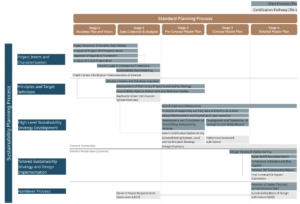
Figure 5.2: Terra Nexus’ Sustainability Planning Process with Certification Pathway
7. Beyond KPIs: Sustainable Urban Planning
Although great emphasis is put in the definition and tracking of each sustainability aspect’s developed Key Performance Indicators, these metrics have been assembled as to better provide a structure to the overarching sustainability report. It is imperative to state, however, that the sustainability consultant’s overarching role of identifying potential solutions for project-specific challenges that may come as design progresses spans beyond a simple KPI evaluation exercise. It is necessary for such particularities to be adequately assessed throughout the overarching report, where clear demonstration of a project’s unique features and design intention is to be provided.
When sustainability aspects are carefully studied and integrated early on, the sustainability expert can support the wider team or urban planner, architects and engineers imagine and consider a new approach to urban developments that create value to both people and the planet.
Above all, our sustainability framework has communication at its core, and it is this framework’s main focus to provide our clients with a better understanding of when and where such communication is critically necessary.
This proximity allows for a seamless and much more integrated participation in the overarching design process, while also guaranteeing our clients’ expectations and needs are promptly met.
8. Outcomes and Conclusions
With the development of this Framework, Terra Nexus seeks to provide a structured approach to integrate sustainability in the overarching urban planning process, while streamlining expected deliverables and expectations required at each stage of the design, further allowing our clients to preemptively cater for our team’s coordination requirements and approach.
From early stages of project location and preliminary arrangement assessments to the coordination and alignment of different specialties’ solutions and the overarching project’s vision, identified sustainability aspects are carefully integrated into the way urban planners, architects and engineers see and imagine new urban developments, creating value to both people and the planet.
Although highly structured, this framework seeks to be fully adaptive to different planning structures and stages, while still being capable of serving as a baseline for the implementation of our sustainability service approach.
This way, we can guarantee both client satisfaction and our objective of implementing real and impactful measures on every project we are involved in, thus contributing to a positive impact in the planning sector within the GCC, MENA region, Europe and every other region we are to operate in.